
Training Nemotron to be 98x Better at Solving Multimodal Puzzles (Unlisted)
 Michael E.
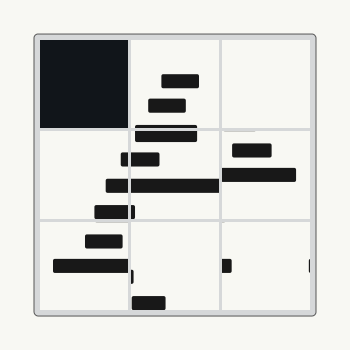
We used NeMo-RL to train NVIDIA’s Nemotron 3 Nano Omni, a 31B-parameter multimodal model with roughly 3B active parameters per token, on simple visual sliding puzzles. In each puzzle, the model must rearrange the tiles of a photograph to match a reference image. At each step, the model receives the current board state and moves the tiles by calling a tool.
The experiment builds on NVIDIA’s sliding-puzzle example in NeMo-RL, which trains Qwen2.5-1.5B-Instruct on numbered boards represented as text.
Text board from NVIDIA’s example
  +---------+
1 | 1     3 |
2 | 4  2  5 |
3 | 7  8  6 |
  +---------+
     1  2  3
In that example, validation success rises from roughly 27% to 70% over 120 updates on numbered boards up to 5×5.
We extend this setup to image-based puzzles, tracking puzzle-solving performance and changes on other multimodal benchmarks during training.
Puzzle environment
At each turn, Nemotron sees the current board and the target side by side. It calls the tool slide_tile with the row and column of the tile it wants to move. The environment executes the call and returns a new screenshot to the model.
The following tool call selects the tile in the second row and second column of the current board:
{
  "function": {
    "name": "slide_tile",
    "arguments": "{\"row\": 2, \"col\": 2}"
  }
}
Only a non-empty tile adjacent to the blank can move. An illegal selection or malformed call ends the attempt, as does running out of moves. The model is given a reward of 1 if the entire board matches the target and 0 otherwise. Moving a tile closer to its destination earns nothing on its own.
Each move adds a fresh screenshot of the current board and goal to the conversation. Earlier screenshots, tool calls and tool results remain in context. In our context-management ablations, keeping this full history performed best and reached the highest solve rates over training.
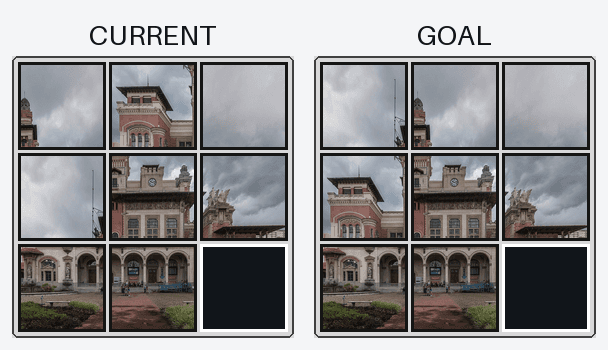
Current + goal
slide_tile
{"row": 2,
 "col": 2}
Tool call
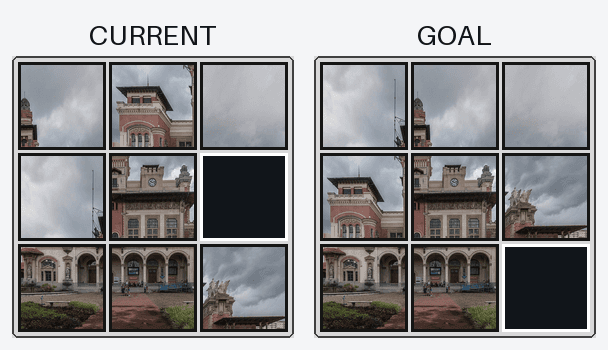
Updated current + goal
Next turn if the attempt continues
Try one yourself
Click or tap a tile next to the empty space to slide it.
Your puzzle
Goal
0 moves
GRPO training
We use NeMo-RL to train with Group Relative Policy Optimization (GRPO), which learns by comparing rewards across responses to the same prompt.
For each starting puzzle, Nemotron samples 16 attempts. When some succeed and others fail, their rewards differ from the group baseline, giving successes positive advantage and failures negative advantage. This provides a learning signal without a separate value model.
Our puzzle runs use a leave-one-out baseline, comparing each attempt with the other 15 attempts in its group. When those rewards vary, the relative advantage is
Ai=Ri−μ−is−i+ε
Here R is the attempt’s binary reward. μ is the mean reward of the other 15 attempts, and s is their sample standard deviation. The small constant ε is 0.000001. If the other attempts have no reward variation, we skip division and use the reward minus the baseline.
For example, if four of 16 attempts solve a puzzle, each success gets an advantage of about +1.93 and each failure about −0.58. If every attempt in the group succeeds or every attempt fails, their advantages are zero. Groups with mixed outcomes provide the reward-based learning signal.
Training setup
Training used a single node of eight NVIDIA H200 GPUs for both rollout generation and gradient updates. Starting from the base model, we trained the vision and language weights in full with AdamW at a peak learning rate of 1e-5. LoRA was disabled and the unused audio components were frozen.
Each update combines 32 of these groups into a batch of 512 trajectories. We keep a fixed mix of eight groups on smaller boards (2×2) and twenty-four on larger boards (3×3). The larger-board groups are spread evenly across starting distances of one through eight moves.
Difficulty is the minimum number of moves needed to solve a board. Each attempt allows two extra moves. Exact distances and solutions stay inside the environment.
Training results
Training reward measures the fraction of sampled attempts that solve the puzzle. The curve shows each batch and its trailing ten-update average.
- Raw per-update reward
- Trailing 10-update mean
The ten-update mean training reward rose from 0.467 at update 200 to 0.761 at update 750. Illegal moves fell from 56.6% of evaluation turns before training to 0.38%.
On the larger development panel, Nemotron solved all 48 puzzles starting within three moves of the goal and 50 of 80 at distances four through eight.
Puzzle evaluation
We measure full-puzzle completion on a fixed development panel of 88 2×2 puzzles and 128 3×3 puzzles built from held-out photographs. We evaluate before training and every 25 updates, using greedy decoding and unchanged move limits.
Photographs are held out, but layouts can overlap. The smaller board has 11 reachable scrambled layouts for a fixed goal. The larger board has 267 within our one-to-eight-move range, before rotations and reflections.
By update 750, the larger-puzzle solve rate was 98× the base model’s on the same development panel.
| Development panel | Before training | Step 750 | Change in points |
|---|---|---|---|
| 2×2 | 6 / 88 · 6.8% | 77 / 88 · 87.5% | +80.7 |
| 3×3 | 1 / 128 · 0.8% | 98 / 128 · 76.6% | +75.8 |
| Combined | 7 / 216 · 3.2% | 175 / 216 · 81.0% | +77.8 |
- 2×2 · 88 puzzles
- 3×3 · 128 puzzles
Transfer to text-based puzzles
We also tested the base model and step 750 in NVIDIA’s text-based sliding-puzzle environment with thinking enabled. On 168 matched puzzles, solve rate rose from 15.5% (26/168) to 22.6% (38/168), a 7.1 point gain.
We suspect training taught some puzzle-specific behavior that remains useful when numbers replace pixels, even with a different action format. This suggests limited transfer within the task, not a general reasoning improvement.
Multimodal evaluation
We evaluated step 750 on five of NVIDIA’s reported multimodal benchmarks in both thinking and non-thinking modes, covering spatial reasoning, diagrams, OCR and visual question answering.
The table shows our checkpoint’s scores alongside NVIDIA’s published base-model results from its technical report and model card.
| Benchmark | Non-thinking · NVIDIA base | Non-thinking · Step 750 | Thinking · NVIDIA base | Thinking · Step 750 |
|---|---|---|---|---|
| CV-Bench 2D | 84.20% | 85.03% | 84.00% | 83.16% |
| AI2D | 88.50% | 88.31% | 88.50% | 84.03% |
| OCRBench | 88.30% | 88.20% | 86.60% | 85.50% |
| MMMU | 55.20% | 54.78% | 70.80% | 67.44% |
| MathVista | 71.90% | 71.30% | 82.80% | 80.70% |
Base scores are NVIDIA-reported references; step-750 scores are measured locally.
The strongest gains remain in puzzle solving. The completed external evaluations do not show a consistent improvement in broader multimodal performance.