
Why DeployCo and ServiceCo Are Betting on the Last Mile
 Sam J.
 Agustin G.
 Drew M.
 Arya F.
Today’s frontier models are increasing in capability by the hour. Within enterprises, potential energy is being transformed into kinetic energy as frontier models are now capable of doing end-to-end work in domains beyond coding. However, most of this kinetic energy is not being converted into useful work.
Today, most enterprises will boast having a Claude or GPT license, maybe both. In many cases, the early gains accrue at the individual level: faster drafting, quicker analysis, better research, and more efficient task completion. But the most accretive gains will come from AI systems that coordinate work across teams, functions, and systems; where agents do not just help one person move faster, but help the organization operate differently. The ones turning those licenses into margin-moving operational gains are a much smaller club.
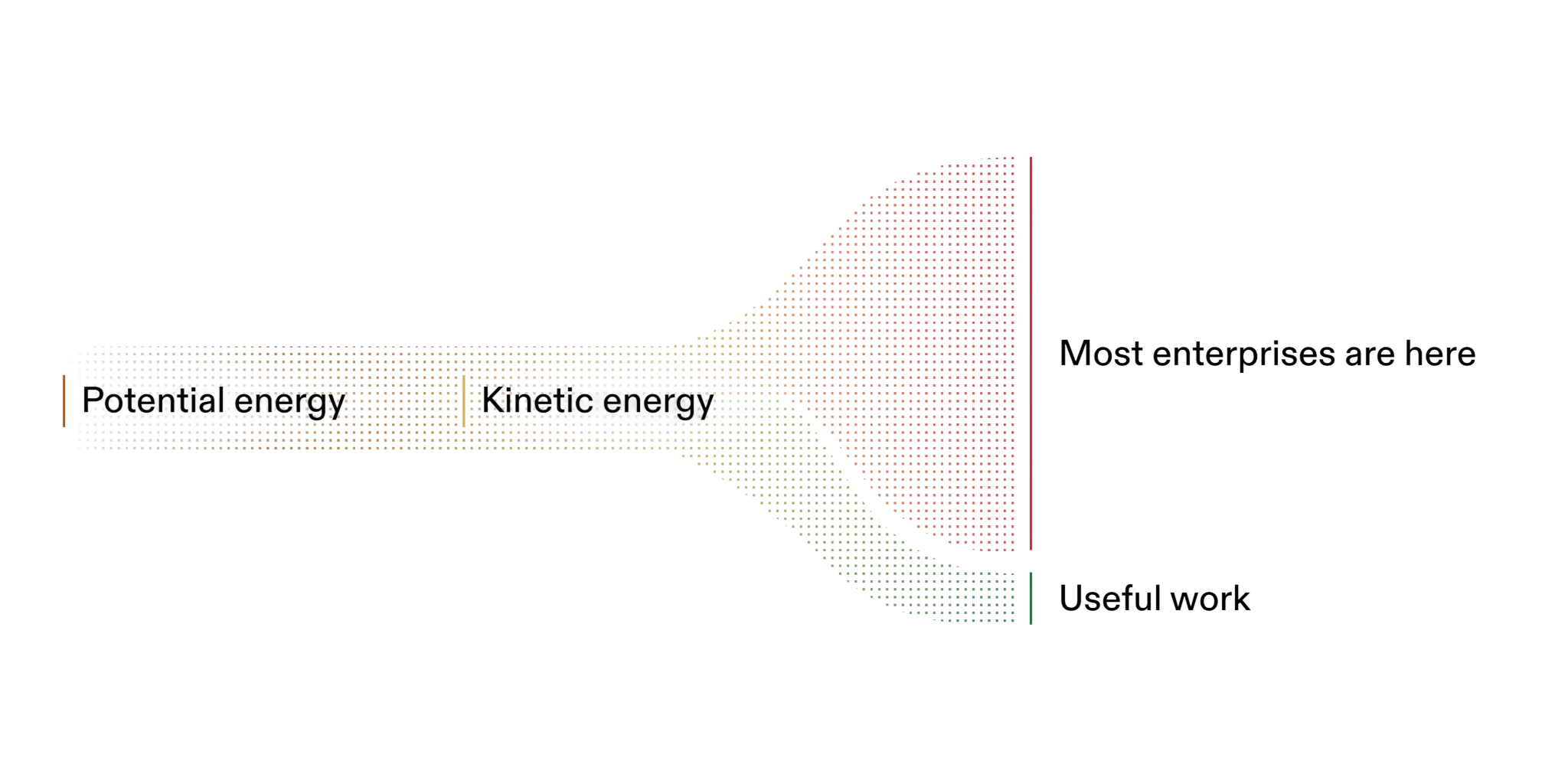
Frontier models come out of the box as highly capable individuals, not as native team players. They can answer questions, draft analysis, write code, and complete isolated tasks with impressive fluency, but enterprise usefulness depends on more than raw capability. Real business operations are messy: every function has its own systems, workflows, assumptions, permissions, and standards for what counts as a correct answer, which means the model cannot simply be smart in the abstract; it has to understand where it sits in the organization, how its output will be used, who needs to trust it, and what other systems or people it needs to coordinate with. The hard transition is turning these models from impressive standalone performers into reliable organizational teammates, which is ultimately a messy system integration and enterprise context problem.
DeployCo and ServiceCo
The frontier model providers are waking up to the fact that this implementation gap is the difference between being a useful tool and becoming a permanent part of the enterprise stack. To deeply entrench themselves inside the IT budgets of frantic CIOs and CTOs, they need to prove that their models can move beyond isolated usage and become deeply embedded in the workflows, systems, and operating cadences where companies actually run. Over the past few weeks, this implementation question has evolved into a must win battle ground for the frontier labs. Recently, OpenAI and Anthropic both announced new deployment-oriented companies, suggesting that the next phase of enterprise AI competition may depend as much on implementation capacity as model capability.
OpenAI announced the OpenAI Deployment Company (“DeployCo”) as a new company focused on helping organizations build and deploy AI systems across important enterprise workflows. As part of the launch, OpenAI agreed to acquire Tomoro, an applied AI consulting and engineering firm, bringing roughly 150 forward-deployed engineers and deployment specialists into the new company from day one. The broader effort also includes a multi-year investment partnership led by TPG and co-led by Advent, Bain Capital, and Brookfield, with other institutions involved as OpenAI looks to expand its enterprise deployment footprint. The company’s stated role is not simply to provide model access, but to work with organizations on the practical steps required to identify priority workflows, build AI systems around them, and make those systems reliable enough for day-to-day use.
Anthropic announced a similar but differently structured effort through a new AI-native enterprise services company (“ServiceCo”) formed with Blackstone, Hellman & Friedman, and Goldman Sachs. This company is intended to help mid-sized businesses bring Claude into core business operations, with Anthropic embedding engineering and partnership resources directly into the standalone firm. Anthropic has said its applied AI engineers will work alongside the services company’s engineering team to identify where Claude can have the most impact, build custom solutions, and support customers over time.
We think that DeployCo and ServiceCo are interesting leading indicators for where the enterprise AI market may be heading:
Frontier labs must become larger and stickier enterprise budget owners. The frontier labs already have broad enterprise awareness, meaningful adoption, and deep technical usage across many organizations. The next challenge is converting that presence into larger, more durable budget ownership through new applications of old system integration playbooks that have long entrenched the software incumbents of the past ~20+ years. Furthermore, to justify the GDP-denting scale of infrastructure investments behind frontier AI, these companies need enterprise customers to treat AI not just as a promising tool, but as a recurring operating layer tied to productivity, efficiency, and business transformation. That requires moving from enterprise license access to enterprise outcomes: helping CIOs and CTOs connect AI spend to measurable workflow improvements, cost reduction, and organizational leverage.
Model capability is becoming a weaker standalone moat. Having the “more capable” model still matters, especially at the frontier, but it is becoming harder to rely on raw capability as the only source of differentiation. State-of-the-art performance is converging across the leading labs, and open-source models continue to improve quickly in the background. As the capability gap narrows, the more durable enterprise advantage may come from context: which provider understands the company’s data, workflows, systems, permissions, and business processes well enough to make its model useful in production.
Enterprise AI will require distribution, operating context, and top-down advocacy. DeployCo and ServiceCo both reflect the reality that enterprise adoption is not just a technical implementation problem. It is also an organizational problem. AI systems need access to the right data, integration with existing tools, trust from business users, sponsorship from senior leaders, and enough change-management support to move from pilot to production. That is why the partners around these efforts are private equity firms, financial institutions, and other enterprise-adjacent operators. They bring distribution, credibility with management teams, and the kind of enterprise “street smarts” that can help turn AI from an experiment into an operating priority.
The Open Questions Around the Last Mile
DeployCo and ServiceCo are meaningful steps toward solving the last mile problem, but enterprises are living organisms filled with idiosyncratic complexity and ambiguity. The challenge is that enterprises are not static environments. Their teams change, their workflows evolve, their data systems sprawl, and much of their institutional knowledge lives outside formal systems of record. A deployment that works for one business unit at one point in time may need to change as the organization changes around it. If a team doubles in size, the system may need to be reintroduced, retrained, or redesigned around new users and new processes. If a team shrinks, the knowledge held by departing employees, including their judgment, shortcuts, assumptions, and technical context, does not automatically get preserved.
This makes enterprise AI implementation less like a one-time software rollout and more like an ongoing alignment problem.
Models need access to data, but data alone is not enough. They also need context: how work actually gets done, which assumptions matter, what exceptions occur in practice, who needs to approve the output, and how different teams interpret the same workflow. Without that context, even strong AI systems can become brittle. They may work well in a narrow pilot, but struggle as soon as they encounter messy handoffs, ambiguous ownership, incomplete information, or changing business conditions.
There is also a potential chicken-and-egg problem for the frontier labs. To make models truly effective inside enterprise environments, they need exposure to the messy reality of enterprise work: incomplete data, implicit assumptions, changing workflows, edge cases, approvals, and the judgment calls that sit between formal systems. But to get that exposure at scale, they first need enterprises to trust their models enough to deploy them inside sensitive business processes. In other words, the labs may need successful enterprise deployments to generate the real-world workflow data that makes future enterprise deployments better. This means deployments may need to become dual-purpose: they must solve a customer’s immediate business problem while also capturing, structuring, and packaging enterprise workflows into useful training signals for the models themselves.
At AfterQuery, we spend our time working on both sides of this problem. We partner with frontier labs to improve the capabilities that will make enterprise AI systems more useful in production, and we work with enterprises to understand where those systems break when they meet real workflows, messy data, and organizational context. That vantage point matters because the gap runs in both directions: labs do not always see how brittle, unstructured, and idiosyncratic enterprise workflows can be, while many application companies building for the enterprise do not have a clear view into where frontier model capabilities are heading next. We use that perspective to help labs develop capabilities against real-world enterprise failure modes, and to help enterprises build systems that are aligned with where the models of tomorrow are likely to improve.
Enterprises will likely work with a mix of AI providers over time: DeployCo, ServiceCo, other vendors, and internal teams. As that ecosystem evolves, companies will benefit from owning the context that makes their AI systems useful: their workflows, assumptions, permissions, exceptions, decision standards, and the practical knowledge that often sits outside formal systems of record. This context is what allows a model to move from answering questions in isolation to operating reliably inside a specific business environment. The goal should be to make that context durable and portable, so it can support whichever model provider, implementation partner, or internal deployment path an enterprise chooses. If solving this context problem is something you are thinking about at your enterprise, please reach out to sales@afterquery.com.